联系我们

Contact Us

服务热线

售前咨询:0574-8813-4072

服务热线:400-865-5169


在线客服

工作日 08:30-17:30
快速响应您的需求


项目咨询

随时咨询我们


图片展示
图片展示
图片展示

NEWS

图片展示

DTCT Insight: Supercomputing Data Center Design Standards Take Effect — DTCT’s Green Supercomputing Data Center and Its Low-Carbon Route

2021-12-02 09:00:00


Abstract

The group standard Design Requirements for Supercomputing Data Centers, co-edited by Zhejiang DTCT Data Technology Co., Ltd., was officially implemented on November 11 under the standard number T/CCUA 016-2021.
The State Council recently issued the Action Plan for Carbon Peaking Before 2030, proposing the 'Ten Actions for Carbon Peaking', including the key actions for green and low-carbon energy transition and energy conservation & carbon reduction efficiency improvement. Strengthening energy conservation and carbon reduction of new infrastructure represented by data centers and promoting the use of green energy power supply for data centers can not only boost energy conservation and emission reduction in the communications industry, but also advance the green and low-carbon transition of energy and open up low-carbon pathways.


Standard Interpretation


1. Purpose and Scope


This document specifies the general requirements and design requirements for equipment layout, architecture and structure, electrical systems, air conditioning and water supply & drainage, network and cabling systems, and intelligent systems of supercomputing data centers. It aims to ensure safe, stable and reliable operation of supercomputers with advanced technology, reasonable economy, safe applicability, energy conservation and environmental protection. The applicable users include owners, design institutes, constructors and supercomputing equipment suppliers with planning and design demands for supercomputing data centers.
This standard applies to the planning and design of newly-built, reconstructed and expanded supercomputing data centers, and may also apply to other types of high-performance (high-speed, high-density) computing centers.

2. Main Chapter Contents


This standard contains ten chapters, one normative annex and one informative annex, namely: 1 Scope, 2 Normative References, 3 Terms, Definitions and Abbreviations, 4 General Requirements, 5 Equipment Layout, 6 Architecture and Structure, 7 Electrical Systems, 8 Air Conditioning and Water Supply & Drainage, 9 Network and Cabling Systems, 10 Intelligent Systems, Annex A (Normative): Infrastructure Configuration Requirements for Supercomputing Centers and Annex B (Informative): Design Guide for Power Transformation & Distribution Monitoring and Management Systems.

3. Interpretation of Main Contents


(1) Definition of Supercomputing
Although supercomputing has attracted widespread public attention, during the formulation of this standard, we consulted many professionals on the definition of supercomputing and received diverse answers. Baidu Encyclopedia defines a supercomputer as a computer capable of processing massive datasets and high-speed operations that ordinary personal computers cannot handle. In terms of components, supercomputers and ordinary computers share basically the same constituent parts, yet differ greatly in performance and scale. Supercomputers feature two major characteristics: extremely large data storage capacity and ultra-fast data processing speed, enabling them to carry out tasks across many fields that humans or ordinary computers cannot accomplish.
Comparing supercomputers with personal computers may easily cause misunderstandings that supercomputers are merely more powerful PCs, which is not the case. First, personal computers are not comparable to supercomputers in software, hardware and performance. Second, supercomputers have no special requirements for data storage volume; their storage capacity serves fast data processing rather than acting as a data warehouse. Although component names may look similar to those of ordinary computers, the actual components are vastly different. After extensive consultations, most industry experts believe this definition is inaccurate. To begin with, a supercomputer is a computing system composed of general or special high-performance hardware and software. Small and medium-sized supercomputers may adopt general high-performance hardware and software, while large and extra-large supercomputers must be built with dedicated high-performance hardware and software. Furthermore, unlike computers in ordinary data centers, a supercomputer is a high-performance computing platform that delivers computing power. Storage capacity accounts for a large proportion in ordinary data centers, whereas computing capacity dominates the total capacity of a supercomputing center.
Based on extensive investigations and combined with opinions from multiple supercomputing professionals, the drafting group finally separated the concept into two terms: supercomputer and supercomputing data center.
A supercomputer refers to a high-performance computing platform built on general or dedicated high-performance hardware and software to provide computing power for complex data, algorithms and applications. It may also be referred to as high-performance computer, parallel computer or giant computer.
A supercomputing data center, commonly known as a supercomputing center, is a building facility that provides an operating environment for centrally deployed supercomputer equipment. It can consist of one or multiple buildings, or part of a single building.
(2) Composition of Supercomputing Centers
As a branch of data centers, supercomputing centers share characteristics of ordinary data centers while having many unique requirements. In terms of site zoning, they are not much different from conventional data centers, yet there are major discrepancies in equipment layout and technical requirements compared with data centers defined in GB50174. The biggest difference lies in the supercomputer room, namely the host room defined by GB50174. The computing performance of a supercomputing center is mainly guaranteed by computing nodes, high-speed network nodes, storage nodes and management nodes. The supercomputer room we define consists of functional zones including computing nodes, high-speed network nodes, storage nodes and management nodes. Among them, computing nodes are the core part determining supercomputing speed and have the greatest differences from the host room design requirements specified in GB50174.
The composition of supercomputing centers references the functional zoning of GB50174 while fully considering the features of supercomputing centers. A supercomputing center comprises functional zones: supercomputer room, auxiliary area, support area and operation management area. Apart from the big differences between the supercomputer room and the GB50174 host room, there are also some differences in auxiliary and support areas, especially for liquid-cooled supercomputing centers, while the management area has minor differences.
The supercomputer room consists of a core computer room zone and a general computer room zone. The core zone and general zone may be arranged in separate rooms or within one single room.
The auxiliary area is a site for supercomputer installation, commissioning, maintenance, operation monitoring and management. Compared with conventional data centers, it adds zones such as supercomputing monitoring center and refrigerant charging room. Some small and medium-sized supercomputing centers may not have an independent supercomputing monitoring center; it is integrated with the comprehensive monitoring center. A refrigerant charging room is only required for liquid-cooled supercomputing centers and unnecessary for air-cooled ones.
The support area provides power supply and safety guarantee for the supercomputing center. Functionally, it is almost identical to that of ordinary data centers, yet the system configuration differs greatly. Large and extra-large supercomputing centers can hardly meet Grade A or even Grade B requirements specified in GB50174.
(3) Classification
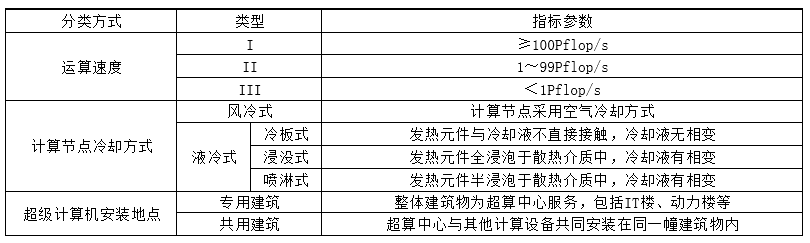
This standard classifies supercomputing centers by computing speed, node cooling mode and installation location (see Table 1), and defines configuration requirements S1 and S2 based on computing speed (see Table 2). S1 applies to national-level supercomputer rooms, and S2 for small & medium supercomputers. Annex A of the standard lists design requirements for S1 and S2 supercomputing centers. Supercomputing centers shall select different infrastructure configuration requirements according to varying computing speeds.
 
Table 1 Classification of Supercomputing Centers
 
Table 2 Correlation Between Computing Speed and Infrastructure Configuration of Supercomputing Centers
 
(4) Layout and Structural Load
Nowadays, liquid cooling technology is increasingly adopted for medium and large supercomputers. Maintenance of liquid-cooled servers requires dedicated service space. For this reason, this standard stipulates that supercomputing centers using liquid cooling technology shall set up an equipment maintenance room.
Equipment in supercomputing centers is heavy, especially liquid-cooled servers; a single cabinet can weigh over 1.5 tons or more, imposing stricter requirements on structural load.
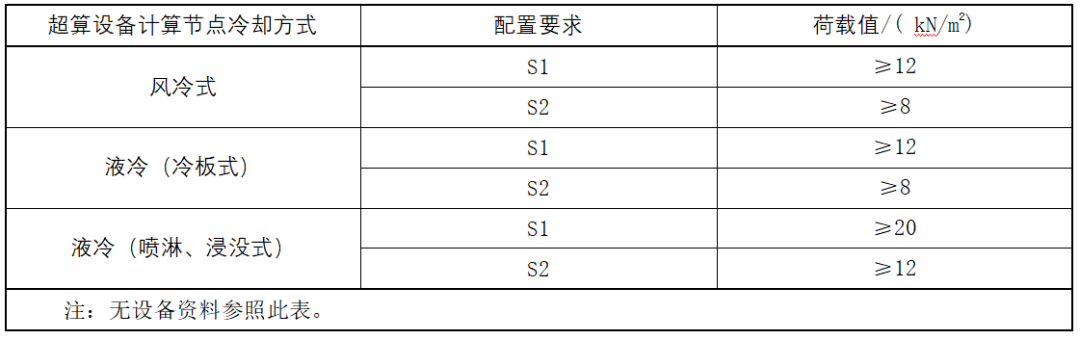
The structural design for installation zones of process equipment and supporting electromechanical equipment shall meet load requirements for equipment operation, and transport corridors shall satisfy transportation load requirements. Reinforcement shall be implemented otherwise. The load of the core computer room zone shall meet equipment installation requirements. Where no clear specification is provided for equipment, the values specified in Table 3 shall apply. Load requirements for other zones shall comply with Annex A.
 
Table 3 Load Requirements for Core Computer Room Zone
 

Related Recommendations

Product Center

DTCT - Modular Micro Data Room All‑in‑One Solution

DTCT - Modular Data Center Solution

DTCT - Industry Application Management Platform

DTCT - Big Data Operation & Maintenance Management Platform

Contact Us

Pre‑sales Consultation: 0574‑8813‑4072

Service Hotline: 400‑865‑5169

Email: dtct@dtctcn.com

Address: No.6, Lane 222, Xingguang Road, Yinzhou District, Ningbo City


©dtctcn.com 版权所有    浙ICP备19015432号-2

Add WeChat friend to learn more about the product
Use Enterprise WeChat
"Scan" to join the group chat
Copy success!
Add WeChat friend to learn more about the product
I see.